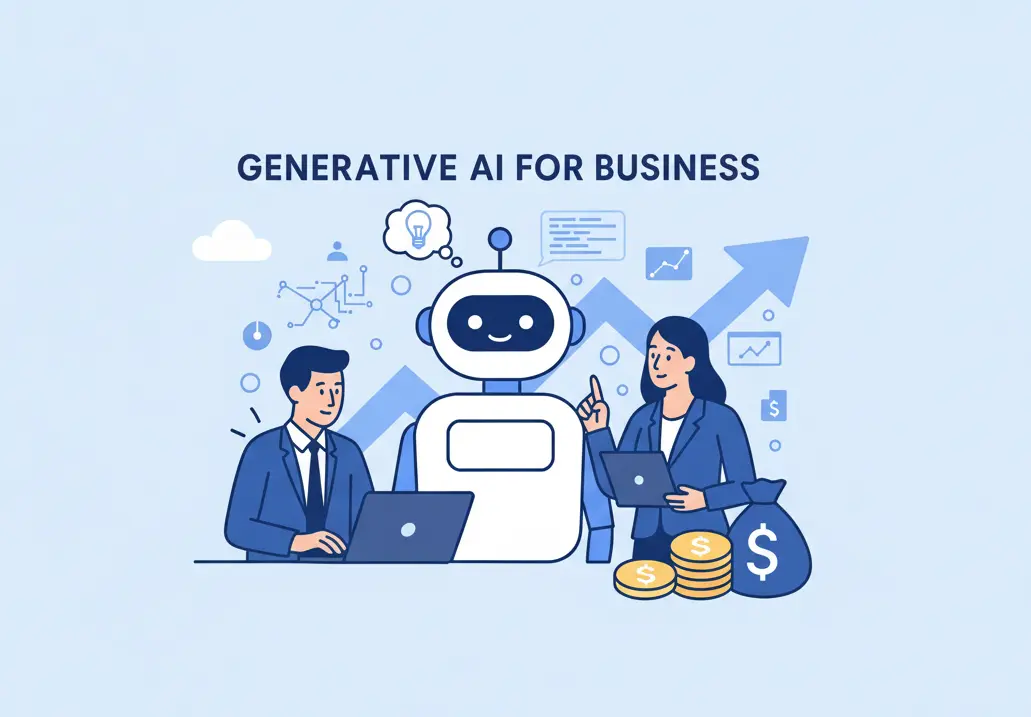
Generative AI and workflow automation are no longer experimental add-ons — they're practical, high-impact tools that reduce repetitive work, speed decisions, and increase consistency across teams. Combined with retrieval-augmented generation (RAG), agent orchestration, and modern workflow platforms, organisations can automate end-to-end business processes while keeping outputs grounded and auditable.
This post explains the building blocks we implement, how they fit together, and a pragmatic privacy/self-hosting approach you can adopt without sacrificing functionality.
Why this matters
Gen AI and automation drive measurable reductions in manual work across customer support, finance, documentation, marketing and internal ops. By combining RAG with agent orchestration and robust automation, organisations get accurate, current answers and can automate end-to-end processes without ripping out their existing systems.
Key building blocks we implement
1. Retrieval-Augmented Generation (RAG)
RAG couples a retrieval layer to a language model so outputs are grounded in the company's own documents and data — which reduces hallucinations and keeps answers up-to-date. We build RAG pipelines for internal knowledge search, customer Q&A, policy summarisation and compliance checks.
2. LangChain-based pipelines
For rapid, maintainable RAG and LLM orchestration we use frameworks like LangChain to assemble connectors, vector stores, prompt templates, and evaluation hooks. This accelerates prototyping and productionising Q&A, summarisation and assistant features.
3. AI agents & multi-agent orchestration
For tasks that require planning, tool use, or multi-step decisioning, agent frameworks like CrewAI let us orchestrate specialised agents that collaborate and share memory. Ideal for SLA-driven ticket routing or automated audit workflows.
4. Workflow automation (n8n)
We link AI capabilities into event-driven automation platforms (n8n) to build end-to-end workflows: document ingestion → embedding & indexing → RAG assistant → n8n workflow to create tickets, update CRMs, or kick off approvals. Visual, node-based, integrates with most enterprise systems.
Concrete examples & expected impact
- Customer support: a RAG-driven assistant answers common queries and auto-creates/enriches tickets on escalation — faster first response, lower manual workload, consistent answers.
- Finance & invoicing: auto-extract invoice data, validate against rules, trigger approvals — less manual reconciliation.
- Documentation & onboarding: searchable, versioned summaries for internal manuals; auto-suggest updates from live changes.
- Marketing & content: first-pass drafts, campaign ideas, auto-populated content calendars from a single brief.
Privacy-first: self-hosting and open-source models
Why self-host?
Self-hosting gives you direct control over data flows, model access and retention — critical for GDPR/HIPAA or regulated contexts. It reduces (or removes) the need to send sensitive data to third-party inference endpoints and avoids vendor lock-in.
Deployment patterns
- On-prem (fully private): everything runs inside the company datacenter or private cloud.
- Private cloud / VPC: inference and data stores in your AWS/GCP/Azure account, private subnets, strict IAM.
- Hybrid: sensitive data and models run on-prem; less sensitive workloads use cloud inference for scale.
- Edge: small quantised models on local devices for latency or air-gap constraints.
Open-source tools & frameworks
- Hugging Face ecosystem: Transformers + vLLM, TGI, Inference Endpoints for production serving.
- Ollama: easy local/private LLM runtime, great for experiments and local deployments.
- LangChain: compose retrieval, prompts, tool calls and evaluation hooks reproducibly.
- Vector stores: Milvus, Weaviate, Chroma — self-hostable, private similarity search.
- Serving & acceleration: vLLM and TGI for batching, multi-GPU orchestration and reliability.
Security, governance & ops best practices
Self-hosting improves privacy only if you implement solid security and governance. Misconfigurations leave systems exposed — recent research has found open Ollama servers reachable on the public internet.
- Network isolation: private subnets, VPCs, mTLS, API gateway auth.
- AuthZ/AuthN: IAM policies, OAuth/OIDC, short-lived tokens, request-level audit logs.
- Encryption: at rest (disk, backups) and in transit (TLS).
- Data governance: redact/pseudonymise PII before ingestion; strict retention and access logs.
- Human-in-the-loop: approval steps for legal, compliance and finance outputs.
- Runtime safety: monitor outputs, rate limit, filter for prompt injection.
Example architecture (RAG + self-hosted inference + automation)
- Document ingestion: PDFs, email, knowledge base → cleaned, PII-redacted → chunks → embeddings in a private vector DB.
- Vector DB: Milvus/Weaviate/Chroma inside the private network.
- RAG server: retrieval + prompt templates (LangChain) → local model inference (TGI/vLLM/Ollama).
- Agent orchestration: multi-step work coordinates CRM, finance, and internal tools via authenticated service accounts.
- Automation: n8n listens for events and executes actions — all inside the private network.
- Observability: every retrieval and output logged for traceability and compliance.
Model selection & lifecycle
- Choose by capability and cost: smaller, quantised models are fast for vertical tasks; larger models generalise better.
- Fine-tuning vs prompt engineering: RAG + good prompts often suffices; fine-tune for domain-specific language.
- Versioning & rollback: pin versions, stage candidates, plan for rollback.
- Security updates: track CVEs for your serving stack; restrict access to model artefacts.
Tradeoffs & risks
- Cost & complexity: self-hosting needs infra, GPUs, and engineering ownership.
- Security surface: misconfigured servers get exposed — treat them like production services.
- Model maintenance: open models need periodic evaluation and updates.
A practical rollout roadmap
- Audit & risk mapping: classify data, identify sensitive flows, choose deployment pattern.
- Small pilot (4–6 weeks): one team (support or finance), self-hosted vector DB + a small/medium model. Measure deflection and time saved.
- Ops & hardening: auth, network controls, encryption, logging, rate limiting.
- Scale & MLOps: version models, CI/CD for prompts/configs, monitoring dashboards.
- Governance: policy for model updates, oversight thresholds, incident playbook.
Conclusion
Gen AI + RAG + agents + automation can dramatically reduce repetitive work and increase speed and consistency. If privacy or regulation matters to you, self-hosting and open-source model stacks let you keep control while still gaining productivity — as long as you invest in the ops and security posture to run them safely.
Ready to modernise your operations with AI and automation? Talk to us about a privacy-first rollout.